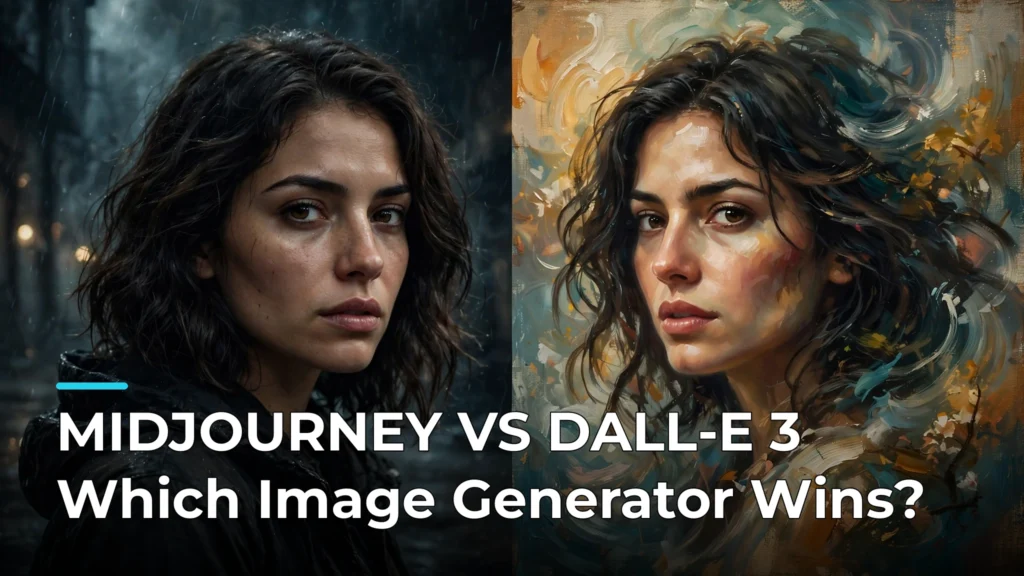
Midjourney vs DALL-E 3 is the debate every creator eventually runs into: two giants, two completely different philosophies. Midjourney is the artist — painterly, cinematic images with a signature look, accessed through a purpose-built web app. DALL-E 3 is the assistant — living inside ChatGPT, understanding plain-language prompts, and refining images through conversation.
In 2026, both have matured significantly. Midjourney’s current model (V8.1) generates images in about 4 seconds with dramatically better text rendering than earlier versions, while DALL-E 3 remains the easiest image generator on earth to use because it is just… ChatGPT. This Midjourney vs DALL-E comparison covers image quality, ease of use, pricing, commercial rights, and real-world use cases so you can pick the right one for your work.
Table of Contents
The Quick Verdict: Midjourney vs DALL-E
If you only have 30 seconds: choose Midjourney if image quality and artistic style are your priority — its default output looks like finished art with minimal prompt effort. Choose DALL-E 3 if ease of use and workflow integration matter most — it lives inside ChatGPT, understands conversational prompts, and costs nothing extra if you already pay for ChatGPT Plus. For most bloggers and marketers, DALL-E 3 through ChatGPT Plus ($20/month) is the better value; for designers, artists, and anyone selling visuals, Midjourney wins on output quality.
Midjourney vs DALL-E 3: Head-to-Head
Image Quality
Midjourney still sets the bar. Its signature is a distinctive “house style” — cinematic lighting, rich detail, painterly composition — that makes even simple prompts look like finished artwork. The V8.1 model (default since mid-2026) improved text rendering, added inpainting and outpainting tools in the web editor, and generates standard images in about 4 seconds. For concept art, book covers, hero images, and anything where aesthetics carry the message, Midjourney’s output needs the least post-processing of any mainstream generator.
DALL-E 3 produces clean, accurate images with exceptional prompt adherence. Its superpower is understanding: ChatGPT rewrites your casual prompt into an optimized one before generating, so “make a cozy coffee shop logo with warm colors” actually produces a coherent logo. Text rendering is excellent — DALL-E 3 spells words correctly in images far more reliably than most competitors. But its default style is flatter and more “stock photo” than Midjourney’s; achieving a distinctive artistic look takes more prompting effort.
Winner: Midjourney for artistic quality and style. DALL-E 3 wins for prompt accuracy and text-in-image reliability.
Ease of Use
DALL-E 3 is the easiest AI image generator available, full stop. There is no new interface to learn: you open ChatGPT, type “create an image of…” and iterate conversationally (“make the sky more purple,” “add text that says SALE”). It is also accessible through multiple entry points — ChatGPT (free tier with daily limits, Plus, and Pro), Microsoft’s Image Creator (free with a Microsoft account), and even Perplexity Pro.
Midjourney has come a long way from its Discord-only days. You now sign up at midjourney.com with a Google or Discord account and generate from the web app’s Create page — no Discord required for basic use. But you still need to learn its parameter syntax (–ar for aspect ratio, –style, –chaos, and so on) to get the most out of it, and the generation model is fundamentally different: you get four variations per prompt and iterate by upscaling, varying, and remixing rather than chatting.
Winner: DALL-E 3 by a wide margin. If you can use ChatGPT, you can use DALL-E 3.
Pricing
Midjourney is subscription-only with no free tier or trial — the free trial was removed in 2023 and has not returned. Four plans, with annual billing saving 20%:
- Basic — $10/month ($8/month billed annually): ~3.3 fast GPU hours per month (roughly 200 standard images), no Relax mode, no private generations.
- Standard — $30/month ($24 annual): 15 fast GPU hours plus unlimited slower Relax-mode generations.
- Pro — $60/month ($48 annual): 30 fast GPU hours, unlimited Relax, private Stealth mode.
- Mega — $120/month ($96 annual): 60 fast GPU hours, unlimited Relax, Stealth mode.
Midjourney sells GPU compute time, not image counts. Extra fast GPU time costs $4/hour on any plan. For most regular creators, Standard at $30/month is the realistic starting point — Basic’s ~200 images go fast once you start upscaling. Note: companies earning over $1 million in annual revenue must use Pro or Mega under Midjourney’s terms.
DALL-E 3 has no standalone subscription — access is bundled:
- Free: limited image generation in ChatGPT’s free tier (a few images per day) and free via Microsoft Image Creator.
- ChatGPT Plus — $20/month: the sweet spot. Generous DALL-E 3 access (roughly dozens of images per rolling window) plus everything else Plus includes — GPT models, file analysis, web browsing. If you already pay for Plus, DALL-E 3 costs you nothing extra.
- ChatGPT Pro — $200/month: effectively unlimited image generation, but overkill unless you generate at industrial volume.
- API: pay per image, roughly $0.04–$0.08 per standard image — the cheapest route for developers embedding generation into apps.
Winner: DALL-E 3 on value. ChatGPT Plus at $20/month bundles image generation with a full AI assistant, undercutting Midjourney’s $30 Standard plan while including far more than images.
Commercial Rights
Both tools allow commercial use on paid plans, but the details differ. Midjourney grants full commercial rights on all paid subscriptions — you own the images and can use them for client work, products, and resale. DALL-E 3 images come with commercial rights through ChatGPT Plus or the API’s commercial terms. One caution: AI-generated images sit in a gray area for copyright registration in the US — you own the usage rights the platforms grant, but purely AI-generated works currently cannot be copyrighted the way human-created works can. For blog featured images, thumbnails, and marketing assets, this distinction rarely matters in practice.
Winner: Tie. Both are safe for commercial blog and marketing use on paid plans.
Best Use Cases
Choose Midjourney when:
- You need striking, artistic visuals — blog hero images, book covers, concept art, brand illustrations.
- You generate images in volume and can use Relax mode’s unlimited slower queue (Standard and up).
- You want a distinctive aesthetic without heavy prompt engineering.
- You need private generations (Stealth mode, Pro and up) for client work.
Choose DALL-E 3 when:
- You already use ChatGPT Plus — it is effectively free at that point.
- You need text rendered accurately inside images (infographics, posters, social graphics, thumbnails with titles).
- You want conversational iteration — describing changes in plain English rather than learning parameters.
- You are a beginner who wants results in the first 60 seconds.
Midjourney vs DALL-E Verdict: Which Should You Pick?
Bloggers and content creators: DALL-E 3 via ChatGPT Plus. At $20/month you get image generation bundled with the AI assistant you are probably already paying for, and its text rendering is ideal for featured images and Pinterest graphics with titles.
Marketers and social media managers: DALL-E 3 for speed and text-heavy graphics; Midjourney Standard ($30/month) if your brand needs a consistent, premium visual style across campaigns. Many teams use both — DALL-E 3 for quick-turn graphics, Midjourney for hero creative. Pair either with an AI content repurposing workflow to turn one visual into a week of posts.
Designers and digital artists: Midjourney, no contest. The aesthetic quality, style control, and inpainting/outpainting editor make it a genuine creative tool rather than a convenience feature. Start with Standard; upgrade to Pro when you need Stealth mode or hit Relax-mode queues during busy hours.
YouTubers and video creators: Midjourney for thumbnails that stop the scroll — its cinematic style is tailor-made for click-worthy thumbnail art. Our guide to the best AI tools for YouTubers covers the full creator toolkit beyond images.
Developers and automation builders: DALL-E 3 via API. Pay-per-image pricing ($0.04–$0.08) with no subscription commitment is the most flexible way to embed generation into apps and workflows.
Midjourney vs DALL-E: Tips for Better Images from Either Tool
- Be specific about style: “cinematic product photo, soft window light, shallow depth of field” beats “nice photo of a watch” on both platforms.
- Specify composition: mention aspect ratio or orientation (“wide 16:9 banner,” “vertical portrait”) so the image fits its destination — a YouTube thumbnail and a blog hero need different shapes.
- Iterate, don’t settle: the first generation is a draft. On DALL-E 3, describe what to change conversationally; on Midjourney, use Vary and Remix on the closest of the four options.
- For text in images: keep it short (under 5 words), put it in quotes in your prompt, and expect to regenerate once or twice. DALL-E 3 handles this best; Midjourney’s V8.1 is much improved but still less reliable with longer phrases.
- Check commercial terms: both tools are fine for blog and marketing use on paid plans, but read the current terms if you are selling the images themselves or using them in client deliverables at scale.
Frequently Asked Questions
Is Midjourney better than DALL-E 3?
In the Midjourney vs DALL-E debate, it depends on what “better” means for you. Midjourney produces more artistic, visually striking images with less prompting effort — it wins on pure image quality. DALL-E 3 is dramatically easier to use, understands conversational prompts, renders text more accurately, and is cheaper when bundled with ChatGPT Plus. Neither is universally better; they are optimized for different users.
Can I use Midjourney for free?
No. Midjourney has no free tier and no free trial as of 2026 — the trial was discontinued in 2023 and has not returned. The minimum entry is the Basic plan at $10/month (or $8/month billed annually). If you need free image generation, DALL-E 3 offers limited free access through ChatGPT’s free tier and Microsoft Image Creator.
How much does DALL-E 3 cost?
DALL-E 3 has no standalone price — it is bundled with ChatGPT access. ChatGPT Plus at $20/month includes generous DALL-E 3 image generation, which is the best value for most people. Limited free generation is available on ChatGPT’s free tier and via Microsoft Image Creator. Developers can use the API at roughly $0.04–$0.08 per standard image.
Which is better for YouTube thumbnails?
Midjourney, for most creators. Its cinematic, high-contrast aesthetic is exactly what makes thumbnails clickable, and the V8.1 model’s improved text rendering handles short thumbnail titles well. DALL-E 3 is the better pick if your thumbnails are text-heavy or you iterate on thumbnail copy frequently, since conversational editing is faster.
Can I use images from Midjourney or DALL-E 3 commercially?
Yes, on paid plans. Midjourney grants full commercial rights on all paid subscriptions. DALL-E 3 images carry commercial rights through ChatGPT Plus or the API’s commercial terms. One caveat: under current US guidance, purely AI-generated images cannot be copyrighted like human-created works — but for blog images, ads, thumbnails, and marketing materials, the platforms’ usage rights are what matter, and both cover those uses.
Conclusion: Midjourney vs DALL-E in 2026
The Midjourney vs DALL-E 3 decision comes down to a simple trade: artistry versus convenience. Midjourney remains the image-quality champion — its painterly, cinematic output looks like finished creative work straight out of the generator, making it the pick for designers, artists, and anyone whose visuals need to impress. DALL-E 3 wins on accessibility and value — it lives inside the ChatGPT you may already pay for, understands plain English, and nails text in images.
For most readers of this blog, the practical Midjourney vs DALL-E answer is DALL-E 3 through ChatGPT Plus: $20/month for an AI assistant and a capable image generator is the best deal in AI right now. But if images are central to what you sell or publish, Midjourney’s $30/month Standard plan pays for itself the first time a hero image makes someone stop scrolling. Either way, you are getting image generation that would have cost hundreds in stock photos or designer hours just a few years ago.
Pingback: Canva AI vs Adobe Firefly: Which AI Design Tool Wins in 2026? - Try AI Tools
Pingback: AI Product Photos: Create Stunning Shots Without a Studio